EN
EN  English
 Español
 русский
 Deutsch
Understanding Internal Stresses in Machine Tool Castings
During the casting process, Machine Tool Castings undergo complex thermal cycles as molten metal is poured into molds and cools to solidify. The cooling process is inherently uneven, as different sections of the casting solidify at different rates. This uneven contraction can generate internal stresses, which, if not properly managed, may result in distortion, warping, micro-cracking, or residual stresses that compromise the structural integrity of the casting. Such defects are particularly critical for machine tool castings, where dimensional precision, rigidity, and vibration damping directly affect machining accuracy and long-term performance. Managing internal stresses is therefore a crucial aspect of both casting design and production process control.
Optimized Casting Design
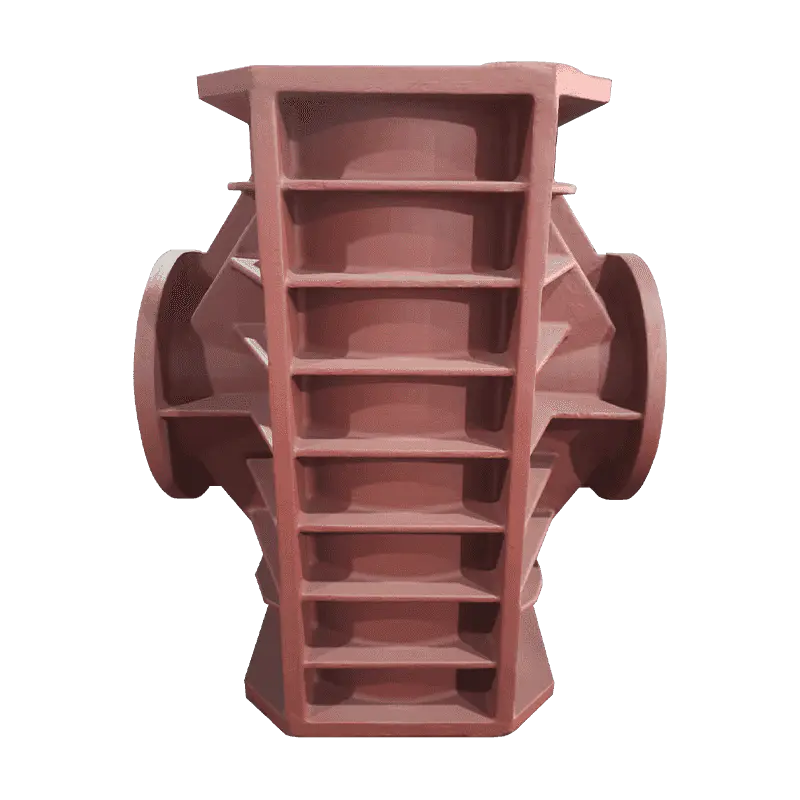
One of the most effective ways to minimize internal stress and potential distortion is through careful and optimized casting design. Designers incorporate uniform wall thicknesses, smooth transitions between thick and thin sections, and strategically placed ribs or gussets to reduce stress concentrations. Abrupt changes in geometry or sharp corners are avoided, as they are prone to accelerated cooling and stress accumulation. Complex features, such as cavities or overhangs, are supported with the use of chills or risers, which act as localized heat reservoirs to control the cooling rate and guide solidification. By ensuring a uniform thermal profile during solidification, these design features reduce shrinkage defects, minimize residual stress formation, and improve the overall dimensional stability of the casting.
Controlled Cooling and Solidification
The manner in which a casting cools has a significant effect on the development of internal stresses. Controlled cooling methods, such as furnace cooling, staged mold removal, or slow air cooling, are employed to reduce thermal gradients that cause differential contraction within the casting. By carefully regulating the cooling rate across different sections of the casting, manufacturers minimize uneven contraction and the resulting stress accumulation. In modern production, thermal simulations using finite element analysis are often performed to predict temperature distributions and identify regions at risk for stress formation. This allows process engineers to adjust mold design, casting orientation, or cooling methods in advance, thereby reducing the likelihood of distortion or cracking.
Heat Treatment and Stress Relief
After solidification, many Machine Tool Castings undergo heat treatment or stress-relief processes to further mitigate internal stresses. These processes involve heating the casting to a controlled temperature below its melting point and holding it for a prescribed period, allowing the internal stresses to redistribute and partially relax. Controlled cooling following heat treatment is equally important, as rapid cooling could reintroduce thermal gradients and residual stress. Stress-relief treatment is particularly important for large, complex, or precision-critical castings, where even minor distortions could affect spindle alignment, guideway precision, or machine stability. This step ensures that the casting maintains its mechanical integrity and dimensional accuracy during subsequent machining and operation.
Machining Allowances and Post-Casting Finishing
Even with optimized design and stress relief, small distortions can occur. To account for this, engineers plan machining allowances on critical surfaces of Machine Tool Castings. After heat treatment, these allowances provide material that can be removed during final machining to achieve the precise dimensions required for assembly, guideway placement, and spindle mounting. Post-casting finishing operations, such as milling, grinding, or surface flattening, ensure that the casting meets strict tolerances and geometric specifications. This combination of stress-relief treatment and precision machining guarantees that the final Machine Tool Casting delivers both stability and functionality in high-performance machining environments.
Simulation and Quality Control
Modern manufacturers increasingly rely on computational simulations to predict internal stress formation during casting and cooling. Thermal and mechanical finite element models simulate the cooling patterns, solidification sequences, and associated stress distribution. These simulations allow designers to optimize mold design, material selection, and cooling strategies before physical production. After casting, non-destructive testing methods, such as ultrasonic inspection, X-ray radiography, or dye penetrant testing, are employed to detect internal cracks, voids, or other defects caused by stress. Continuous monitoring, inspection, and quality control throughout the production process ensure that Machine Tool Castings are produced consistently, meeting both mechanical and dimensional requirements while minimizing the risk of defects.